This guide describes the core principles of using zynthian. It is essential that you understand these core principles. Each view has its own help page that describes in more detail the workflow of the page.
There are five knob actions:
The fundamental building block of zynthian's sound architecture is the processor. A processor generates or manipulates audio or MIDI signals. Zynthian includes over 1000 processors to choose from.
Processors are grouped together and interconnected within chains. Chains are a key concept in zynthian. The first thing you will do after powering-on your zynthian for first time, once you stop celebrating your success, is to create a chain and add some processors. It does little without any chains!
Processors may be positioned within the chain in series or in parallel. The quantity of chains or processors in each chain is only limited by available computing power. Audio signals from chains by default feed a stereo mixer with typical mixer strip controls: fader, balance, mute, solo, phase reverse, etc. Audio processors may be positioned pre-fader or post-fader. (Note that zynthian treats most audio as stereo.)
The audio and MIDI signals are routed between physical inputs, chain inputs, chain outputs, physical outputs and processor side-chain inputs. This provides a lot of flexibility whilst maintaining a simple, chain-based approach to signal routing. (See Chain Manager help for details.)

There are five fundamental processor types:
Each type of processor is categorised to ease user selection, e.g. Synths have categories: Synth, Sampler, Piano, Organ, Acoustic & Percussion.
Each processor has parameters that may be controlled with zynthian knobs or mapped to MIDI CC messages. (See control view help for details). Processors may have presets that may be arranged in banks. (See preset view help for details.)
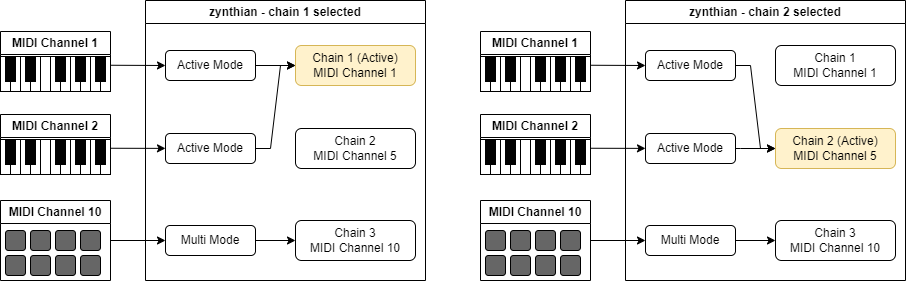
Chains receive MIDI data from a set of MIDI inputs. These could be external MIDI devices connected to MIDI DIN-5, USB MIDI, network MIDI or internal sources like the built-in sequencer. They can be enabled for each chain separately. Each MIDI input can work in 2 different modes:
When a MIDI input is configured in active mode, the active chain receives all MIDI input from it and all MIDI events are translated to the active chain's MIDI channel. This is the default mode for all MIDI inputs. When using active mode you don't need to worry about the MIDI channel your keyboard or controller is using. You change which instruments are played by changing the active chain in your zynthian. (See mixer view for details.)
Active mode's behavior can be modified by the Active MIDI channel global flag. This may be enabled in the admin menu and has the following behaviour:
When a MIDI input is configured in multitimbral mode, only those chains matching the input's MIDI channel will receive data from this input. No MIDI channel translation is performed. Multitimbral mode allows receiving and managing each MIDI channel individually. Each MIDI input selects the chains it drives using the MIDI channel. If you are using an external sequencer or a MIDI controller that sends on multiple MIDI channels, you may want to use multitimbral mode.
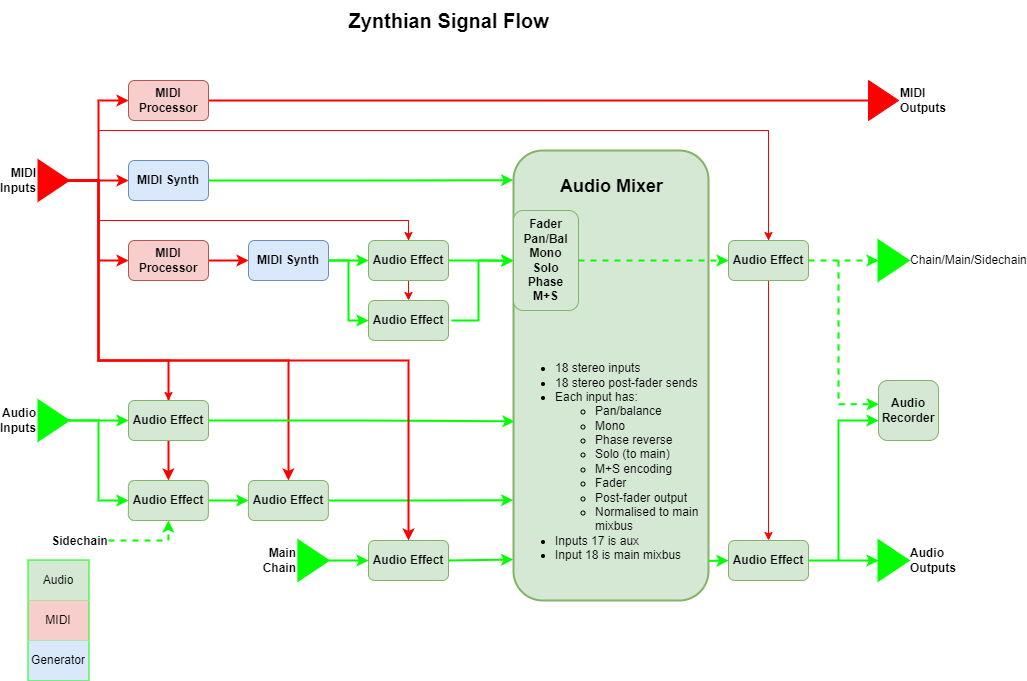
As introduced above, zynthian's signal workflow is based around chains of audio & MIDI processors that feed an audio summing mixer and MIDI outputs. This diagram gives an overview of signal paths which may help in understanding the flow of audio and MIDI signals.
A snapshot is the captured state of zynthian at the time of saving the snapshot. Snapshots are saved in a JSON file with .zss extension and can be loaded at any time, which effectively restores the state of the zynthian device when the snapshot was saved. Snapshots include:
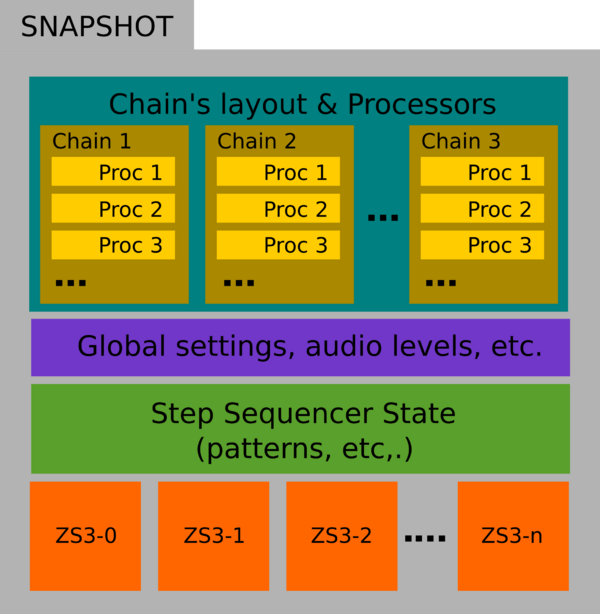
ZS3 means zynthian Sub-SnapShot. A ZS3 is a partial state that is stored in memory and can be recalled very fast. Each ZS3 can easily be associated (or learned) to MIDI Programs, i.e. program change events. Of course, every ZS3 is saved and restored within its snapshot. When a snapshot is first loaded, it uses the default sub-snapshot called, ZS3-0.
See ZS3 view help for how to save and restore a ZS3 with a MIDI Program Change message.
Each ZS3 includes: